

Testimonials
-
[icon name=”quote-left” prefix=”fas”]
Client Interviews can get into sensitive areas. When my client asks that their customers be interviewed for useful feedback, lots of ideas are open for discussion.
One of the reasons a 3rd party can get more honest information about subject (my client) is I am independent. I am not serving the interviewee and there is no relationship to be protected.
We sometimes tell the person in the airline seat beside us some facts about ourselves which we won’t tell a good friend. People have the need to get “issues off their chest”, safely.
I make it possible for people to tell me suggestions, complaints and other things anonymously. Their identity will be protected. It is the comment that is important.
If multiple people make a common comment, that needs to be passed along because it is a significant issue for some reason. Their identity is not the issue.
I have done this for various organizations: changing the wording enough so the original idea is kept but the sources are safe.
This provides the interviewees with enough anonymity that they are willing to be interviewed, and pass along feedback that is worth commenting on.
Then the result will be information that my client can learn from, and then use to adapt/grow/shift/improve/change…
The Policy On Anonymity Of Interviewees
-
[icon name=”quote-left” prefix=”fas”]
It’s easy to pay a person or company in order to get positive comments.
But those quickly kill credibility
The Feedback And Reputation Report is not an easy project.
Believable comments from real clients, organized but not guided by an independent 3rd party are important.
All professionals and businesses need to “keep their finger on the pulse”, and be open to critiques.
For ratings to be considered truly independent, the system needs to:
- Collect feedback directly from clients/customers.
- Use transparent methodologies.
- Are not directly controlled by the rated companies.
- Regularly update their ratings to reflect current customer satisfaction levels.
The quality standards of rating systems based on feedback
-
[icon name=”quote-left” prefix=”fas”]
Each F.A.R. (Feedback And Reputation) Report needs to deliver good ideas and easy to use marketing tools.
When we learn WHY the customers/clients of a client are more loyal, that is valuable. Our client can then make sure those methods are consistently used.
Getting above average results is the goal. Here are some ways the insights learned are used.
Finding Insight Clients felt more valued when their service provider remembered small personal details about their business or past projects. Personalized follow-ups and proactive recommendations improve long-term retention. Many clients reported that service providers were enthusiastic in the sales process but became unresponsive after securing the contract. A structured post-sale communication plan (e.g., check-in emails or milestone updates) significantly impacts client satisfaction. Clients often referred service providers not based on major successes but on small, consistent positive experiences (e.g., quick email responses, problem-solving attitude). Agencies and service providers should track and leverage micro-moments of client delight, not just big project wins. Clients who understood exactly what they were paying for were more likely to refer the company, even if the price was high. Detailed breakdowns of costs, even in premium-priced services, increase perceived fairness and trust. Many business clients preferred to pay extra for services that saved them time, particularly in accounting, consulting, and legal services. Messaging around ‘time saved’ rather than ‘cost savings’ resonates more with high-value clients. Evidence In Action
-
[icon name=”quote-left” prefix=”fas”]
The clients of 4 different business coaches were interviewed and their comments were analyzed. Here are their Best Practices, in order of how important each of those factors is to the approximately 100 clients. There was no specific question asked about “Best Practices”: the questions covered a number of experiences and processes. The coaches are located near Vancouver, New York and Florida; the clients are all over North America. The clients ranged from solopreneurs to senior management in billion dollar public companies.
Best Practices
- Active listening and effective communication
- Tailoring approach to client’s needs
- Providing fresh perspectives and insights
- Creating a safe and comfortable environment for sharing
- Integrating practical business advice with personal development
- Continuous learning and staying updated with industry trends
- Using various tools and assessments
- Encouraging self-reflection and critical thinking
- Maintaining professionalism while building strong relationships
- Offering clear, actionable advice and follow-up
- Facilitating networking and connections among clients
- Balancing structure with flexibility in coaching sessions
- Providing both one-on-one and group coaching experiences
- Using relatable examples and metaphors to explain complex concepts
- Focusing on organizational culture and team dynamics
This is one of the possible sections in the Feedback And Reputation Report. Another of the possible Report sections is the gap between the overall Best Practices and the actual services standards of an individual coach. This can be part of the internal use information.
The external use information includes testimonials with permission to use, and stories about client’s experiences which are valuable in networking and presentations.
Discover the guidance your clients will generously suggest. That is what the FAR Report does: it depends on carefully using the trust your clients already have with you, and transfers some trust to our interviewer. That is then the tool that opens up their honest, not always careful comments. Your clients are not afraid of damaging their relationship with us. Their comments do hold their real feelings. When a number of different interviewee/clients have common themes to their ideas, you should listen.
Are you curious about what will guide your improvement? Let’s talk about what questions can be asked of your clients. I will guide you on the mix of clients to be interviewed. Your current and past clients have the loyalty to suggest your ideal growth.
Best Practices For Business Coaches – According To Their Clients
-
[icon name=”quote-left” prefix=”fas”]
In every marketing and sales system, the first step always includes “gathering information and learning”.
The value of that time and expense is a critical early step. Results of that new information should lead to:
• More new client opportunities
• Less cost in gaining new clients
• Less churn/turnover in current clients
• More profit per client
• More clients getting an increased set of services from the agency
• More satisfied staff
• More referrals: current and past clients telling others about their positive experiences and boost in incomeWhile there is no perfect solution, a Feedback And Reputation Report from Gap Management can provide clear, specific and manageable points.
Instead of stories, let’s work the numbers. As an example, the fees for a full Report with all regular sections is $4,250 Canadian/ or $3,100 US.
The following numbers come from a variety of sources. These figures are appropriate for a digital marketing agency with less than 15 staff/contractors.
Costs Of Getting A New Agency Client
• Making first contact
• Building relationships
• Discussing options
• Preparing proposal and presentation
• Onboarding, first 2-3 months
Only after that is the income from the client to the agency moving toward a profit.Sales Cost
If an agency owner/partner or client development professional earns $90,000 per year, and does attend networking events, maintains referral partnerships, builds relationships, spends time researching, makes 2 or more presentations to a potential client, involves other agency specialists regarding SEO, PPC, social media, design, copywriting and more – then a new client can cost $5,000 to $10,000 to acquire.Onboarding Cost
As the first 2-3 months of the new client setup and onboarding can be 40-60% of the income.Churn rates above 30% are serious. 15-25% are common. Reduce churn and profit is boosted.
Based on the above numbers, a FAR Report that takes 4 hours of agency time, before the full Report is delivered, is a reasonable consideration.
Cost Of Churn, Per New Client
Form Approximate Cost Notes SEO, PPC, social media, memberships, networking $1,000 Online and in-person networking, communications, reputation development Direct Client Development: making first contact in person & building trust $200 Moving contact from acquaintance to prospect Developing relationship with new contact, research, emails, phone/video conversations $500 Learning about the specific business/professional firm; answering questions; competitive positioning Presentation & Proposal Development $500 Preparation and delivery of presentation with detailed new actions & Ideas Onboarding $4,000 First 2 months of high service Total: New Client Development $6,200 in costs And the above costs are reduced after the first few months after the Report results are used. Beyond that, the efficiencies and increased value continues when guided by specifics in a Feedback And Reputation Report.
How a Report shifts the economics:
• Preferred client vs Average client: Improved targeting. Focused networking and referral partnerships are very effective
• More insight: Deeper understanding of a niche – motivations, issues, their preferred clients. New potential clients look for an agency “that gets us, we don’t need to waste time”.
• Clear communications: preferred communication methods used, on a reasonable basis
• Client Development personnel with appropriate StoryFrames (for conversations) and battle cards (to answer specific objections in a presentation)
• Narratives and actual stories: evidence of experience
• Testimonials: social proof with details
• Social media with real examples: more evidence to reinforce the agency’s reputation
• Improved media and influencer relations: able to deliver to the right media in the appropriate waysFor details, contact Gap Management and let’s discuss improving your positioning, client types and more.
Ask for some of free tools from Gap Management. eg How To Use The Stories Your Clients Tell About Your Agency:
When you get stories from current and past clients, with their permission to use, they are excellent in new Client Development actions. Ask to receive Gap Management’s free “Storytelling Guide” or “Networking Notes” to improve relationship-building. Both are very appropriate for marketing high-value services such as marketing agencies, professional services firms, home renovators/remodelers, and business coaches.7 Ways the FAR Report Saves Budget and Boosts Profit for Digital Marketing Agencies
-
[icon name=”quote-left” prefix=”fas”]
By analyzing detailed feedback from about 70 clients of business coaches, the top 2 topics mentioned that would be most attractive for potential clients are:
Adaptive Leadership in Changing Times:
Many decision-making clients expressed concerns about navigating industry changes and adapting to new realities. A thought leadership piece could focus on strategies for leaders to remain agile and effective in rapidly changing business environments.A senior executive in a professional firm praised the coach’s ability to understand “the complexity of people.” Another said they valued “coaching in the sense of value proposition.”
Enhancing Communication and Team Dynamics:
A number of interviews highlighted the importance of improving communication within organizations. A thought leadership article could explore innovative techniques for improving team communication and collaboration, especially in hybrid or remote work settings.One client mentioned the coach “facilitated open dialogue”.
Instead of offering a wide variety of downloadable documents or presentations, those 2 topics get enough interest to make that focus worthwhile. When a business coach is choosing marketing media and message choices, there are too many options. Focus on the top ones that fit your preferred clients. Prove your coaching is not set, but dynamic and adapts as the economy and social issues shift.
Top 2 Thought Leadership topics for Business Coaches
-
[icon name=”quote-left” prefix=”fas”]
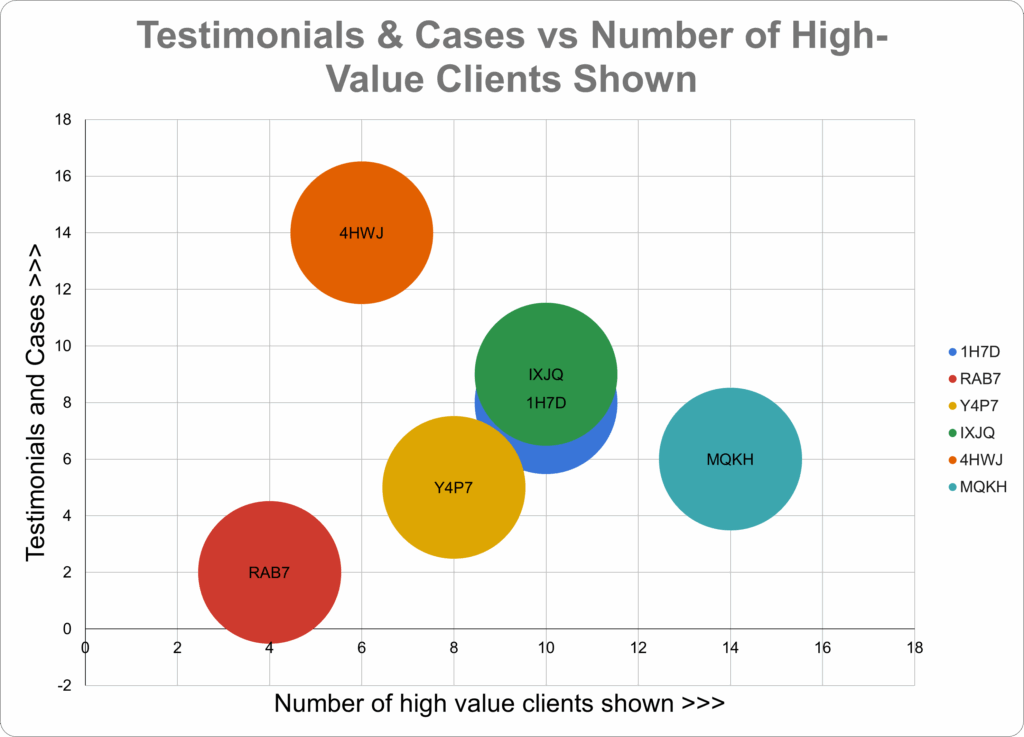
When we look at a list of potential clients, a lot can be learned visually. This is a number of marketing agencies, the number of testimonials and stories showing on their website; compared to the number of high-value clients they have.
When an agency’s clients are well positioned, it shows up in loyalty/reduced churn, more services used, and more referrals.
High-value clients typically give fewer testimonials because they see it as “less professional”. That’s where one of the Feedback And Reputation Report excels. Our clients usually get about 16 very detailed testimonials plus stories in their FAR Report. By adding some of those testimonials over time, SEO results get boosted as “social proof” is demonstrated.
And more detailed testimonials are powerful with potential clients.
Sample Positioning Chart To Understand A List

-
[icon name=”quote-left” prefix=”fas”]
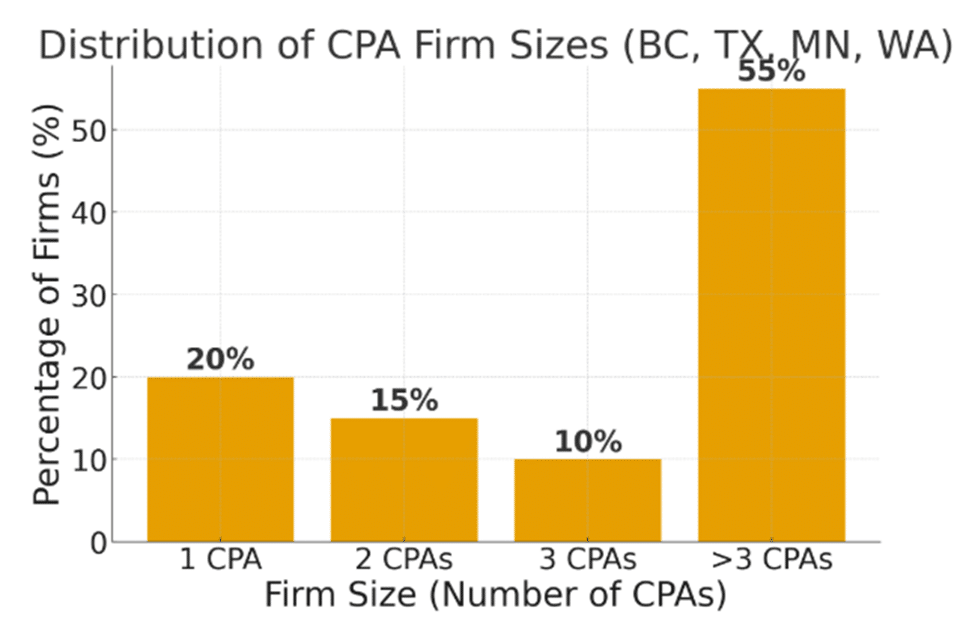
This simple chart shows the percentage of CPA firms by size in 4 separate regions, using a small sample overall. Because the overall number of firms reviewed is small, this chart is a rough estimate, for discussion purposes only.
When a marketing agency or other services provider is working to gain new CPA clients, they can position the individual firm based on business, finance or tax sectors, size, and more.
Some describe the differentiation as Positioning, Branding, Identity and other terms. These somehow describe the firm so potential clients can quickly understand if a firm is right for them or not.
Ways To Compare. The competitive qualities of a CPA firm are partially based on the number of CPAs, and partially based on the following factors: range of major services; experience in specific business, investment and tax sectors; communication skills; number of support personnel; software expertise; responsiveness to client or tax department queries, and more.
That complexity leads to slow decisions as potential clients try to get a “feel” for each potential CPA firm who might serve them. The decision is intellectual and emotional.
Testimonials tell a lot. The following is slightly edited but the original message is maintained: “They took the time to explain what they’re doing, what they offer and how it could work, what they expect from us to have a smooth relationship.”
It is within the slow decision process over weeks and months where critical communications have value. The potential client can learn of the CPA firm through a web search, referral from a business colleague, networking at a local event, download a How-To document, listen to a presentation at a Chamber of Commerce event and other media or communications forms.
Each time the potential client listens to or reads about the CPAs, the message needs to be consistent. That common positioning across media builds the differentiation, understanding and trust. Trust is the goal.
Discovering how actual clients learned about a CPA firm, then compared and made final choice over other firms has real ROI. Talk to us about the detailed insights, testimonials, competitive decision factors and more; which are part of a Feedback And Reputation Report from Gap Management.
Ways A CPA Firm Can Be Differentiated
-
[icon name=”quote-left” prefix=”fas”]
That’s a pretty harsh subject line. However, it’s based on a considerable amount of research.
The high-value services provider talking about their specialty and clients:
“We increased efficiency” is forgettable.
The clients of the high value services provider talking about their experiences:
“We went from needing 6 hours every Friday on reports, to only needing 45 minutes” creates a mental picture.When people hear facts, only the language processing areas in their brains are activated. When they hear stories, multiple brain regions light up: sensory, motor, and emotional centers.
Stories create connections in the listener’s brain; and between the services provider and the new contact.
Learn to tell the stories your clients are already telling colleagues and friends. Use a little neuroscience to build a stronger marketing position in their brain; and in their business network.
Don’t believe the services provider; do believe their clients
-
[icon name=”quote-left” prefix=”fas”]
There’s a peculiar paradox at the heart of presenting deeply human feedback through an AI.
That’s the situation when interviews with high-value clients uncover important factors. One person asked another person the questions, and AI analyzed the transcripts.
When a business owner reads that a client said, “They saved my company when I was ready to give up”, that has very human impact.
That emotional weight carries serious credibility precisely because a real human listened to and communicated with another human. The AI tool is merely the vehicle for human truth, not its source. This creates unexpected persuasive power: prospects know the software didn’t fabricate these stories or massage the testimonials.
Real people said these exact words to a real interviewer who cared enough to probe deeper when answers seemed surface-level.
Why AI For Analysis
When the Feedback And Reputation Report was done nearly 20 years ago, analysis was manual. Imagine coding interviews, or copy/pasting sections into a spreadsheet of about 15 main questions plus secondary questions, with about 30 interviewees. Then the analysis would start. Days later it would be ready to present. Now that process takes less than 30 minutes with AI, and then a few hours of review and manage the insights.
The credibility of the Report multiplies client’s praises, suggestions and issues because AI can’t replicate the subtle follow-up questions that yield the most powerful insights. When an interviewer hears hesitation and asks, “What almost made you leave before that turnaround?”; capturing the client’s honest admission about nearly firing the firm; that’s human intuition creating documentary evidence.
The AI simply presents what humans discovered through the irreplaceable act of genuine conversation. Many marketing claims are dismissed as copywriter persuasion or AI-generated fluff, but word-for-word quotes from named clients, captured in structured interviews, carry weight that no software algorithm can manufacture.
Perhaps most ironically, using AI to deliver human feedback actually highlights the authentic human labour behind the report. When prospects interact with the chatbot and realize these aren’t templated success stories but actual transcribed conversations with identifying details, documented contexts, and raw emotional truth, those prospects grasp immediately that humans did the real work.
The technology becomes transparent. It’s just a delivery system that emphasizes rather than obscures the human connection at the core.
This is the persuasive edge: AI presenting evidence of deeply human interactions creates credibility that pure AI-generated content can never achieve.
The Irony of Human Truth Delivered by Silicon