

Testimonials
-
[icon name=”quote-left” prefix=”fas”]
Most service providers struggle with the same question: What do I say that will actually resonate with the decision-makers I want to reach?
The typical approach is to guess. We write what we think clients care about. We describe our services the way we see them. We craft messages based on what we hope will land.
And then we wonder why the content feels flat, or worse, why it sounds exactly like everyone else in our industry.
The Confidence Problem
Here’s what’s really going on beneath the surface: most business owners aren’t confident in their marketing content because they’re working from assumptions rather than evidence.
Think about the difference between these two scenarios:
Scenario A: You’re writing a case study and you describe your process as “thorough and detail-oriented.”
Scenario B: You’re writing that same case study, but you have a usable statement of a client saying, “I’ve worked with three other firms before, and none of them caught the issues you found in the first week. That saved us from a very expensive mistake.”
Which version are you more confident sharing? Which one will your potential clients actually remember?
What Changes When You Have Real Customer Language
When we systematically gather feedback from your clients, through in-depth conversations, not just satisfaction surveys. something shifts.
You stop guessing what matters to them. You get evidence.
You receive, in your client’s words, why they chose you, what surprised them, and what they tell others about working with you. You discover the emotional moments in their experience that you might have overlooked because you were too close to the work.
You get details from about 80% of the list, so the findings are reliable. About 2/3 give permission for their long comments to be used as testimonials.
Then we analyze all those comments for valuable patterns and insights.
Suddenly, content development changes from a creative struggle to a curation exercise. Instead of inventing messages, you’re selecting from a library of authentic experiences.
Testimonials about your services and team stop sounding generic. Your case studies include the specific details that make stories memorable. Your website copy uses the same phrases your prospects are already thinking.
The Ripple Effect on Your Marketing
This isn’t just about having better quotes for your website.
When you understand how your best clients describe their experience, that clarity flows into everything: the way you explain your services on a discovery call, the stories you tell at networking events, the topics you choose for thought leadership content.
You find yourself speaking with more certainty because you’re not speculating about your value, you’re reporting what you’ve learned from the people who’ve experienced it firsthand.
That confidence is contagious. Potential clients sense when someone truly understands the outcomes they deliver versus when someone is hoping their marketing claims are accurate.
A Different Starting Point
The Feedback And Reputation Report that Gap Management produces isn’t just a research document. It’s a foundation for all the communications: external and internal..
When we do 20 to 30 structured interviews with a client’s customers, we capture the language, stories, and insights that transform marketing from guesswork into something grounded in real experience.
The output includes ready-to-use content assets, but more importantly, it provides clarity. Business owners walk away understanding not just what their clients value, but why—and that understanding makes every piece of future content easier to create and more compelling to read.
Gap Management helps high-value service providers discover what their clients really think, and turn those insights into marketing content that works. Learn more about the Feedback And Reputation Report at GapManagement.org
Creating Marketing Content Gets Easier When You Know What Your Clients Actually Think
-
[icon name=”quote-left” prefix=”fas”]
The infographic below illustrates important file and information protections. Financial industry clients need to be able to answer quetions without fear, employees want to be able give suggestions to management, service’s consumers want to give their comments. They all need to know “it’s a safe place and process”. Gap Management relies on established standards in each step like collecting interviewee’s contact information through to presentation of the final Report.
We don’t understand all the systems we use. What’s important is those processes are agreed on internationally and dependable. MFA/2FA – multi-factor authentication and 2-factor authentication are processes we are all becoming used to so our information is secure. More complex systems like SOC2, HIPAA and GDPR are followed because very large and important industries require those standards are reliably met.
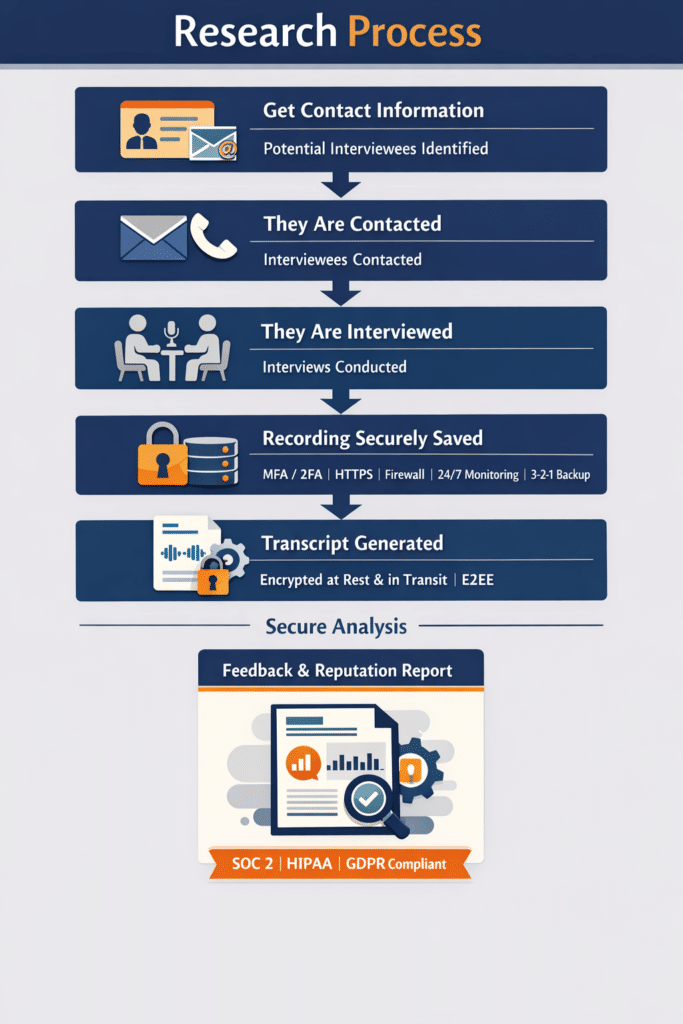
Security Essentials
-
[icon name=”quote-left” prefix=”fas”]
Business networking is widely recognized as essential for career growth and business development. Yet a significant, often overlooked, barrier prevents many professionals from doing it: social insecurity and networking anxiety.
It’s Scary
While roughly 80% of professionals believe networking is crucial to success, a 2026 report indicates that nearly 60% of young professionals actively avoid in-person networking events.This is one of the important sections in the Marketing Library. The Library is a set of documents, questions for conversations, digital assets, statistics and more. Each title in the Library answers specific needs:
Stories and anecdotes your own clients tell about you, which can be easily adapted to fit “my professional title is average: here’s what people say after receiving my services”
Questions to ask when networking which get others talking conversationally and enthusiatically.
What to send after a networking connection is made.
- Good to meet you, what I learned
- Ask what questions they might have you can quickly answer
- Suggest: Here’s something that might help based on your needs (demonstration of expertise and value)
- Anecdote about a business type they are familiar with
4 Points To Record: right after talking with someone, record these:
- Be a connector. Perhaps you know someone who can help them or your new contact can help someone you know.
- When is a good time for you to contact them again
- If you contact them again, on what basis
- Notes and information that keeps you understanding their potential value
The Data on Networking Avoidance & Anxiety
The combination of remote-first work cultures, the aftermath of the pandemic, and the rise of AI has created a “networking deficit”.
• Anxiety Levels: According to a 2025 survey, 46% of professionals say networking makes them anxious. Another survey found 38% of professionals feel anxious before attending such events.
• Avoidance Rates: A 2015 U.S. survey found 53% of adults do very little or no networking. Recent 2026 data shows that 60% of young professionals (Gen Z) avoid in-person networking events.
• The “Gen Z” Gap: 53% of Gen Z workers report that finding new connections is their biggest barrier.
• Specific Insecurities:
– 29% feel socially anxious when faced with real-life small talk.
– 26% dread awkward silences.
– 19% openly admit to hating small talk, making them avoid the events.
– 42% of professionals refrain from reaching out because they feel like they are imposing on others’ time.
• Long-Term Impact: 40% of Gen Z have only one or two people they can turn to for career advice, and 15% have no professional network at all.
Anecdotes and Real Conversations
Based on Ask a Manager, Reddit, and LinkedIn, here are common scenarios where social insecurity leads to avoidance or failure:
• The “Panic at the Event” Scenario: A professional shared they would “silently leave through the door and into the night air” when arriving at events because they couldn’t find anyone to speak with, preferring to remain a “vampire” who needs an invitation to interact.
• The “Failed Introduction” Scenario: A junior employee in a competitive field attended a high-stakes networking event, but due to severe social anxiety, was unable to make eye contact with senior executives, leading to a “plummeting of self-confidence”.
• The “Frozen at the Table” Scenario: A person in a nonprofit sector reported having a crucial contact sitting directly across from them but was “too scared” to introduce themselves. Later, they worried they appeared “stuck up”.
• The “Imposter Syndrome” Scenario: Another professional felt their social anxiety was rooted in a fear of being “phony” or “inauthentic,” causing them to avoid networking entirely because they felt they had nothing of value to offer.
• The “Physical Reaction” Scenario: Some professionals report severe physical reactions, such as sweating or shaking, which they believe makes them appear “distracted” or “weak” to potential mentors or recruiters.Top Four Reasons for Resisting Networking
- Lack of Confidence: Paralyzed by the thought of interacting with strangers and underestimating their own value.
- Too Busy/Stressed: Viewing networking as an added stressor rather than a long-term investment.
- Impatient for Results: Expecting instant leads and becoming discouraged when relationships take time to build.
- Misunderstanding Networking: Believing that networking equals “selling,” which feels slimy to many people.
How Professionals Are Addressing It
• Targeting Small Groups: Rather than large, loud conferences, focusing on niche, smaller gatherings, such as a local coding meet-up.
• “Give Before You Get”: Focusing on being helpful to others first reduces the pressure of the “sales” aspect.
• Setting Small Goals: Instead of “meeting everyone,” setting a goal to have one genuine conversation.
Specific Marketing Library Assets For Networking: These would be based on the specific insights Gap Management learns from the Feedback And Reputation Report on a person and business.
30-second self-introduction. Based on the positive statements of your own satisfied clients, not some average
Referral Partner Talking Points: the best value in networking is making contact with some who can talk about you to others. Potential referral partners need some little memorable stories and they are ready.
Business Case: much more than an anecdote. A great business case is much more than “what happened”. It answers: why someone was chosen over competitors, their positive qualities, the satisfaction of their clients after the engagement. Most importantly, it includes memorable evidence of quality.
Talk to us about how the Marketing Library can answer a number of client development issues.
Networking For The Nervous
-
[icon name=”quote-left” prefix=”fas”]
They don’t suddenly decide.
“There was something missing. It’s difficult to explain but our relationship with them was just feeling reactive and transactional. For the fees, they should have been much better in understanding and communicating.”
That quiet erosion is the norm, not the exception. The decision to leave typically happens 3 to 6 months before the announcement arrives, and often much longer.
The most dangerous accounts aren’t the ones who complain: they’re the quiet ones who pay their invoices, attend meetings, and seem perfectly fine right up until the note arrives that the relationship won’t be renewed.
And it’s rarely about money. When you rank the actual reasons high-value clients walk, price lands only 6th, cited by just 37% of departing clients, while the #1 driver is a lack of proactive strategic guidance.
Clients want a partner who challenges their thinking and helps them see around corners. In other words, they don’t leave for a better deal; they leave because someone else made them feel more valued, more understood, more worth the fee.
The catch is that they almost never tell you directly. Roughly 71% of customers stay silent after a bad experience rather than raising it, so by the time the churn shows up in your numbers, the decision is already made. The signals were there for months: slower replies, a junior contact routing the conversation, referrals quietly drying up; but there was no complaint to respond to.
That’s precisely the gap a confidential, third-party feedback process is built to close: surfacing what clients feel but would never say to your face. Capture those while there’s still time to act on it.
When high-value clients leave for another services provider, it’s very often a surprise.
-
[icon name=”quote-left” prefix=”fas”]
When a client is reconsidering their choice in their current services provider, or in the process of short-listing a new potential services provider, it is very rewarding to have an “ear to the ground”.
Learning how decisions are made can teach a lot. The 4 Trust Development Factors (Expertise/Authority, Reliability, Communications, Longevity/Time) are very important.
Next, we want to roughly estimate how much time or resources are needed to be spent on the variety of ways to communicate. Decision-makers use at least 6 different sources of information before they take action. Those can include: in-person interactions; professional networks, testimonials and reviews, reputation based on comments from peers and others, website and content, public speaking and white papers, media and PR, and video or audio recordings.
Trust Takes Time
Use that factor to build relationships. It’s easy to be distracted and expect fast results. Let your competition fall into the “fast results” trap.By growing those connections in human ways, you will be able to “feel” the trust increase.
Client Decision Intelligence sounds complex. It’s really not. Do ensure the right steps have been taken and the client development will flow. It will feel right when the average client is more enjoyable to work with, takes less effort to gain their business, and they are more loyal.
Analysis of comments about our clients brought out the phrase: “Trust originated in a pre-purchase conversation” very frequently. In a recent review of 7 important segments for us included the insight “trust growth events” across all 7 segments. Those are examples of the great guidance available.
Are your decision-makers ready to learn the insights that comes from in-depth conversations about your firm, and comments about those same decision-makers?
What is Client Decision Intelligence?